The Olympic Torch Milan Cortina is one of the most iconic symbols of the Winter Olympic Games. Behind its essential and refined aesthetics lies a significant industrialization and metalworking process, required to transform a design concept into a real component.
When developing products intended for international events, every detail becomes strategic: geometric precision, surface quality, lightweight construction, and production repeatability must coexist within the same component.
In this context, at Ricos we contributed to the manufacturing of the final section of the Olympic Torch 2026, leveraging our expertise in aluminum tube forming technologies and high-precision finishing processes.
How was the Olympic Torch of 2026 manufactured?
The production of the Olympic Torch Milan Cortina required the integration of several manufacturing technologies capable of ensuring high aesthetic and dimensional standards.
The objective was not simply to produce a metal component, but to create an elegant and seamless shape consistent with the design vision while meeting the industrial requirements of a controlled production process.
To achieve this result, the final section of the torch was developed through a sequence of operations including:
- tube forming;
- tapering;
- rolling;
- 3D laser cutting;
- final assembly.
The uniqueness of the project lies in the integration of these technologies within a process capable of maintaining exceptional surface quality and geometric precision.
From raw material to final shape: the role of aluminum
In the Olympic Torch Milan Cortina, the choice of aluminum was far from accidental.
This material offers particularly valuable characteristics for applications where weight, strength, and aesthetic quality must coexist.
Among the main advantages of aluminum are:
- lightweight properties;
- excellent formability;
- high corrosion resistance;
- superior surface finish;
- ease of processing.
However, its high formability also requires extremely precise control during manufacturing operations, especially when producing complex geometries while maintaining tight tolerances.
The tapering process: creating a controlled and progressive geometry
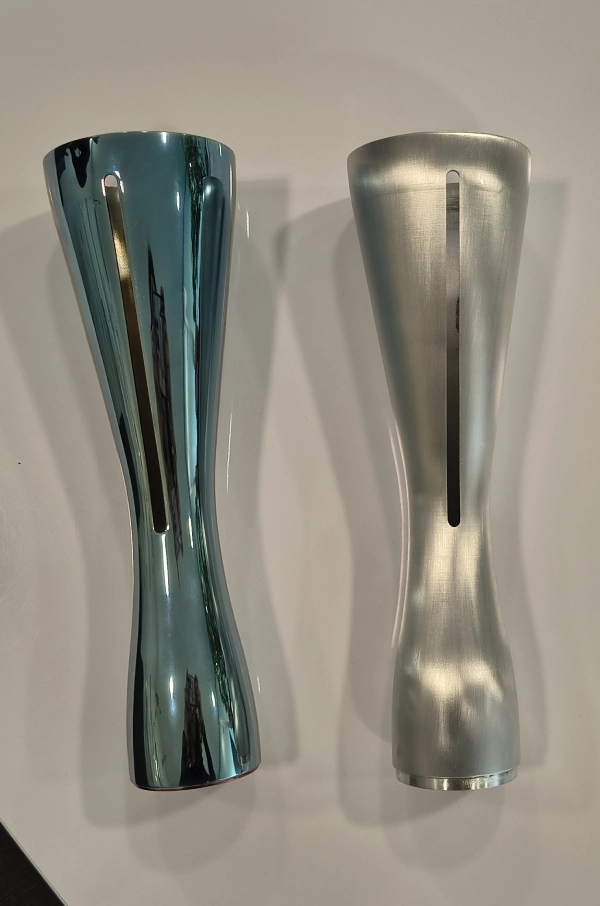
To achieve the distinctive shape of the Olympic Torch 2026, one of the key manufacturing processes was tapering.
Tapering consists of progressively modifying the tube geometry by changing its diameter along its axis.
This operation makes it possible to create smooth transitions between different sections without the need for additional assemblies or visible welds.
From a technical perspective, controlling the deformation process is particularly important because any unwanted variation could affect:
- component symmetry;
- aesthetic quality;
- fit-up with subsequent parts;
- production repeatability.
The process must therefore ensure geometric continuity across the entire surface.
Rolling: when forming becomes precision
The Olympic Torch Milan Cortina required components characterized by extremely precise shapes and visually flawless surfaces.
For this reason, rolling was introduced after the tapering stage.
This technology makes it possible to modify the geometry of the component through controlled deformation, improving both precision and shape consistency.
Unlike more invasive manufacturing methods, rolling helps maintain excellent surface quality while reducing dimensional imperfections.
The result is a component capable of meeting both the functional and aesthetic requirements expected of an object destined to become an internationally recognized symbol.
Why 3D laser cutting was essential
During the manufacturing of the Olympic Torch Milan Cortina, 3D laser cutting played a fundamental role in achieving the precision required by the project.
When working with complex three-dimensional components, traditional machining methods often encounter significant limitations in terms of accuracy and repeatability.
3D laser cutting allows manufacturers to:
- create complex geometries;
- achieve extremely precise edges;
- reduce tolerances;
- improve component fit-up.
This technology also enables direct processing of formed or tapered surfaces while maintaining high quality throughout the entire machined profile.
Final assembly through rolling
One of the most interesting aspects of the Olympic Torch 2026 concerns the assembly stage of the lower section of the component.
In this phase, we again employed rolling technology to join the different elements without compromising the overall aesthetics of the product.
The goal was to achieve a stable and precise connection while maintaining surface continuity.
When manufacturing components intended to represent the excellence of Italian design, even the smallest detail must remain consistent with the original concept.
For this reason, the assembly stage becomes just as important as the previous manufacturing processes.
The real challenge: integrating multiple technologies into a single process
The Olympic Torch Milan Cortina demonstrates a principle frequently encountered in the most complex industrial projects: value does not lie in a single manufacturing operation, but in the ability to integrate multiple technologies within one process.
Tapering, controlled forming, rolling, and 3D laser cutting must work together to ensure:
- geometric precision;
- surface quality;
- production continuity;
- component reliability.
Each stage directly influences the next and requires careful engineering from the earliest development phases.
From concept to component: the contribution of Ricos
The Olympic Torch Milan Cortina is a concrete example of how specialized expertise in tube forming can contribute to the realization of projects with both high technical and symbolic value.
Our contribution focused on transforming the design concept into an industrially manufacturable component through processes capable of ensuring precision, quality, and repeatability.
The experience we have gained in processing metal tubes, plates, and bars enables us to tackle complex applications across numerous industrial sectors, where final quality depends on the effective integration of engineering and manufacturing.
Develop your project
If you operate in sectors such as:
- lighting;
- automotive;
- industrial design;
- energy;
- aerospace;
- plant engineering;
- specialized components;
we can support you in the development of components manufactured through advanced forming technologies, rolling, 3D laser cutting, and integrated production processes.
Contact us to discuss your project and identify the solution best suited to your requirements.