A tube bender machine does more than simply bend a component to a specific angle. In more complex projects, it must be capable of following continuous geometries by progressively changing the radius without creating abrupt interruptions along the profile.
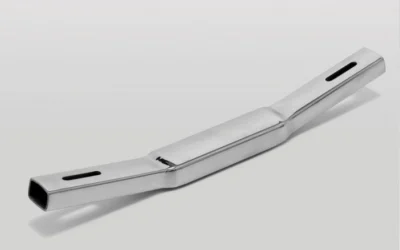
This was the challenge we faced when manufacturing a handlebar for a Decathlon exercise bike. The required shape could not be interpreted as a simple sequence of separate bends. Instead, the component featured a continuous profile designed to meet functional, ergonomic, and aesthetic requirements.
To transform the design into a tube that could be manufactured effectively, we used freeform technology capable of dynamically changing the bending radius as the material advanced through the machine.
The Project: Manufacturing a Handlebar with a Continuous Geometry
The tube bender machine was selected based on the characteristics of the component, rather than from a desire to use a specific technology. The handlebar featured a geometry in which the bends had to develop smoothly while maintaining continuity between the different areas of the tube.
In a component of this kind, shape does not serve an exclusively aesthetic purpose. It affects the position of the grips, the overall dimensions, the interaction with the exercise bike frame, and compatibility with the subsequent assembly points.
The three-dimensional design represented the result to be achieved, but it had to be translated into a sequence of movements compatible with the actual behavior of the material. The challenge was to preserve the required profile while maintaining symmetry, surface quality, and repeatability across all the components produced.
Why Was Conventional Tube Bending Not Sufficient?
With a conventional tube bender machine, the bending radius is generally determined by the die used during the process. This solution is effective when the component features defined, regular, and repeatable bends, but it can become limiting when the radius must change progressively along the same tube.
Producing different geometries may require multiple tooling setups, a change of tool, or the division of the process into separate stages. In the case of the handlebar, this approach could have produced less fluid transitions while increasing production time and process complexity.
The required geometry was not made up of independent bends, but of a single continuous profile. We therefore needed a technology capable of guiding the tube throughout the entire development of the shape, varying the radius without interrupting the forming process.
What Is Freeform Tube Bending?
Freeform tube bending is a technology that progressively modifies the path of the tube while the material advances through the working area. The radius does not necessarily remain constant but can change continuously and dynamically according to the programmed parameters.
Unlike conventional bending, the profile is not produced exclusively through a sequence of bends associated with dies featuring predetermined radii. The machine coordinates the tube feed with the movements required to generate the desired geometry along the entire component.
This solution can be considered when a project requires:
- different radii along the same tube;
- progressive transitions;
- continuous profiles;
- three-dimensional geometries;
- shapes with an ergonomic or aesthetic function;
- components that are difficult to produce using a single fixed radius.
How Does It Differ from a Fixed-Radius Machine?
A fixed-radius tube bender machine generally uses a die whose geometry determines the radius of the bend. It is a precise and effective technology for many industrial applications, particularly when components feature standardized and repeatable curves.
Freeform processing, on the other hand, makes it possible to change the radius as the tube develops. This provides greater design freedom but requires more complex programming and careful process setup.
This does not mean that freeform technology is always the better solution. When a component requires only a few regular bends, a conventional machine may be more efficient. However, when the project includes variable radii and continuous transitions, freeform bending reduces dependence on tooling associated with a single geometry and makes it possible to treat the component as one continuous profile.
From the Three-Dimensional Model to the Machine Program
A tube bender machine does not automatically transform a CAD model into a finished component. Before production begins, the geometry must be analyzed to determine the path, radii, feed movements, rotations, and points where the bending radius changes progressively.
The program must also consider variables that are not fully represented by the theoretical design, including springback, material behavior, and the dimensional changes caused by deformation.
Tube diameter, wall thickness, alloy, and material condition all influence the way the tube behaves during processing. Two components with the same geometry but made from different materials may therefore require different settings.
For the handlebar project, the work carried out by our technical department was essential in transforming a three-dimensional shape into controlled production parameters that could then be repeated consistently.
How Does the Radius Change During the Process?
During freeform tube bending, the radius is modified without interrupting the movement of the component. The machine progressively changes the forming conditions, guiding the material along the path defined by the program.
The synchronization between the tube feed and the movement of the machine axes determines the shape produced in each area of the tube. An incorrectly calibrated variation could create visible transitions, radii that differ from those required, twisting, or asymmetry between the two sides of the handlebar.
The geometric freedom offered by this technology therefore requires particularly precise control. The more continuous and complex the profile, the more important it becomes to define the parameters governing each section of the process correctly.
The objective is not simply to achieve the final shape, but to do so while maintaining consistent deformation along the entire component.
Setting Up the First Handlebar
For a tube bender machine, the first component is not simply an initial attempt, but an essential stage in the industrialization process. The manufactured part is compared with the required geometry to assess the actual behavior of the material and correct any deviations.
For the handlebar, the analysis may involve several aspects:
- continuity of the bends;
- symmetry between the two sides;
- overall dimensions;
- position of the ends;
- surface quality;
- possible ovalization;
- compatibility with the connection points;
- compliance with the reference model.
Based on these checks, the feed movements, paths, and compensation values are adjusted. The real challenge is not producing a single correct component, but ensuring that the result remains stable throughout the entire production run.
Differences Between Hydraulic and Electric Tube Benders
A tube bender machine can use different systems to generate and control the movements required during processing. Hydraulic solutions use fluid pressure to operate one or more elements of the machine, while electric solutions use numerically controlled motors.
Hydraulic tube benders are generally associated with robustness and high force availability, which are important characteristics in more demanding applications. However, the result also depends on the configuration of the system, the adjustment of the hydraulic circuit, and the control of the different movements.
Electric tube benders coordinate the axes through servomotors and digital programs. This type of control can be particularly useful when the geometry requires synchronized movements and dynamic variations.
The choice does not depend exclusively on the drive system, but also on tube diameter, wall thickness, material, geometry, production volumes, and the required performance.
Which Critical Issues Must Be Controlled?
With a freeform tube bender machine, the ability to produce complex geometries does not eliminate the typical challenges associated with tube deformation. During this process, the material is compressed on the inside of the bend and stretched on the outside.
The main aspects to be controlled include:
- ovalization of the cross-section;
- thinning of the outer wall;
- local flattening;
- twisting;
- springback;
- surface marks;
- differences between symmetrical sections;
- uneven transitions between different radii.
Each anomaly may result from the combination of geometry, material, and process parameters. For this reason, process setup concerns not only the final position of the tube but also the quality of the deformation along the entire profile.
From a Feasible Component to Repeatable Production
The tube bender machine makes it possible to produce the required profile, but technical feasibility is only the first step. To bring the handlebar into production, the parameters, operating sequence, and inspection methods must be stabilized.
Industrialization includes verifying repeatability across multiple components, managing tolerances, and storing the correct program for future production batches.
A project can only be considered complete when the geometry can be reproduced with consistent quality, sustainable production times, and clearly defined controls. This is where technology, engineering, and production must work together.
In the case of the Decathlon exercise bike handlebar, the value of the solution did not lie solely in producing a complex shape, but in transforming it into a controllable industrial process.
Where Can Freeform Technology Be Used?
Freeform tube bending can be considered for projects in which the tube must follow a continuous profile or feature variable radii along the same component.
In addition to fitness equipment, this technology can be applied in sectors such as automotive, mobility, technical furniture, lighting, medical components, and specialized tubular structures.
However, every application must be evaluated individually. Material, cross-section, wall thickness, radii, tolerances, and production volumes all influence the actual compatibility of the project with the process.
At Ricos, we begin by analyzing the component to determine whether freeform technology is the most suitable solution or whether the geometry can be produced more efficiently through other tube bending and forming technologies.
Freeform Tube Bender Machine: When Technology Follows the Project
The freeform tube bender machine allowed us to approach the handlebar not as a combination of separate bends, but as a single geometry to be controlled throughout the entire length of the tube.
The value of the project does not depend solely on the machine used. It comes from the ability to analyze the design, assess material behavior, program the dynamic variation of the radius, inspect the first component, and make the process repeatable.
When technology is selected according to the actual requirements of the project, even the most complex shapes can be transformed into industrially manufacturable components.
Do you have a tubular component with variable radii or a geometry that is difficult to produce using conventional bending?
Contact us to present your project and evaluate the most suitable production solution for your company.