Short and long supply chains in the metalworking industry represent two fundamentally different production models, with direct impacts on lead times, operating costs and final product quality. In an industrial context, the supply chain refers to the set of stages that lead from raw material to the finished component, including design, machining processes, quality control and logistics.
Analysing the difference between a short and long supply chain means understanding how the number of intermediate steps, the distance between suppliers and the level of process integration affect overall performance. In a market increasingly focused on speed, customisation and reliability, choosing the right supply chain model is not merely an organisational decision, but a strategic one.
Opting for a shorter supply chain allows companies to reduce complexity and inefficiencies, improving responsiveness to customer needs and increasing overall competitiveness.
Short and long supply chain: what they really mean
In the metalworking industry, short and long supply chains are mainly distinguished by the number of parties involved and the degree of fragmentation of production processes.
A long supply chain involves assigning each phase (design, cutting, machining, treatments and logistics) to different suppliers, often located in different areas. This model can be advantageous for standardised, high-volume production, but it requires complex coordination and increases exposure to delays and unexpected issues.
A short supply chain, on the other hand, drastically reduces intermediate steps and concentrates multiple processes under a single organisational control. When design, production and logistics are integrated, it becomes easier to coordinate activities, monitor quality and maintain control over delivery times.
In the metalworking sector, where precision and production continuity are essential, this level of integration represents a tangible competitive advantage.
How short and long supply chains affect lead times, costs and quality
Short and long supply chains have a direct impact on delivery times, operating costs and final product quality in metalworking. In a long supply chain, transferring semi-finished products between multiple suppliers results in longer lead times, higher logistics costs and increased management complexity. Each transfer introduces potential delays, communication issues and risks of non-conformity.
A short supply chain, by contrast, significantly reduces production lead times by eliminating unnecessary transport and simplifying planning, although it requires higher investment in machinery to manage multiple types of processing.
Process integration within a single facility allows rapid intervention in the event of design changes or unforeseen issues. Quality also benefits from this model: direct control over all stages reduces errors, improves product consistency and increases supply reliability.
Advantages of the short supply chain in the Italian metalworking context
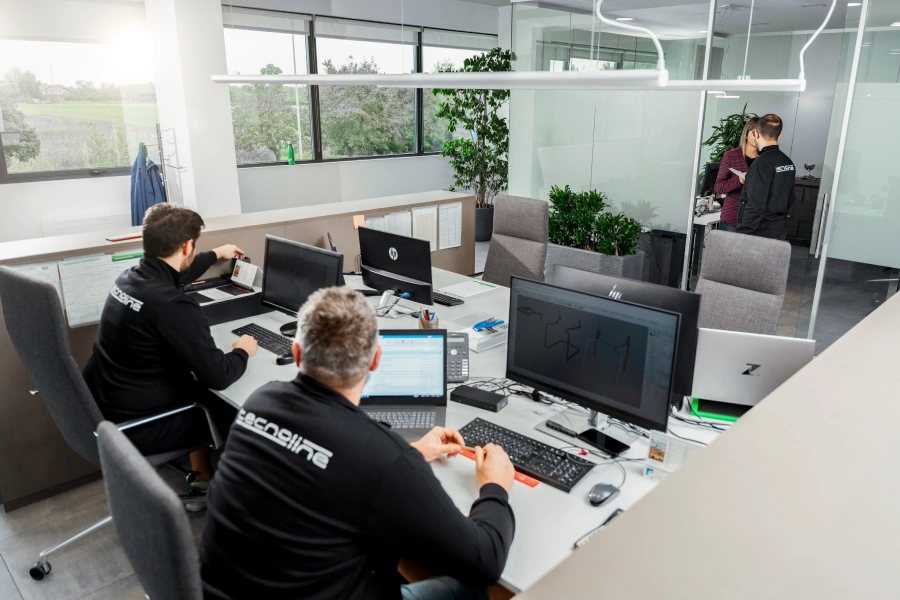
In the Italian industrial landscape, short and long supply chains take on particular significance, especially in the metalworking sector characterised by a dense network of highly specialised SMEs.
The short supply chain offers concrete competitive advantages in terms of production flexibility, faster decision-making and customisation capabilities. By reducing intermediate steps, companies can respond more quickly to customer requests and adapt production to small or medium batch sizes. This approach also helps contain logistics costs and improves internal communication between departments, reducing errors and rework.
The long supply chain may be suitable for high-volume standardised production, but it is more exposed to issues related to price volatility, supply delays and coordination difficulties. In a market where added value is driven by quality and service, the short supply chain becomes a strategic lever.
Process integration: the real strength of the short supply chain
The difference between a short and long supply chain in the metalworking industry becomes particularly evident in the level of process integration. An effective short supply chain is based on vertical integration, meaning the coordinated management of multiple production stages within the same company or facility.
This approach reduces coordination costs, accelerates information flow and improves collaboration between design, production and quality control. In metalworking, integrated processes optimise resource usage, reduce downtime and increase delivery predictability. The ability to monitor and control each production stage in real time enhances overall reliability and improves the quality of service offered to the end customer.
It is precisely this integration that makes the Ricos short supply chain particularly effective in highly complex technical environments.
Short supply chain, sustainability and reduction of hidden costs
Short and long supply chains also have different impacts on sustainability and indirect costs in the metalworking sector. A short supply chain reduces the distances travelled by materials and limits the number of transports, helping to lower environmental impact and overall energy consumption.
This model also enables more efficient inventory management, reducing the need for intermediate warehouses and the risk of waste. Conversely, a long supply chain may conceal less obvious costs, such as prolonged storage, the management of multiple suppliers and greater exposure to logistical disruptions.
Assessing these hidden costs is essential to understanding the true cost of production and making informed strategic decisions. From both an economic and environmental sustainability perspective, the short supply chain is becoming increasingly relevant.
When it makes sense to choose a short supply chain in metalworking
Short and long supply chains are not absolute opposites, but models to be evaluated based on business objectives. The short supply chain is particularly suitable for production that requires high levels of customisation, fast delivery times and strict quality control. It is the ideal choice when flexibility, reliability and customer service are critical success factors.
The long supply chain may be advantageous for high-volume standardised production, provided it is supported by advanced supply chain management systems. In many cases, a hybrid strategy can offer a balanced compromise.
However, in quality-driven metalworking environments focused on long-term customer relationships, the integrated short supply chain often remains the most efficient and competitive solution in the medium to long term.
Short and long supply chain as a strategic choice for metalworking companies
The choice between a short and long supply chain has a profound impact on efficiency, costs and reliability in metalworking companies. In this context, the Ricos short supply chain represents a strategic value for businesses seeking a solid, responsive and technically reliable partner.
Process integration, direct management of operations and internal coordination of production stages allow us to guarantee reliable delivery times, consistent quality and a high level of customisation.
For companies that work with us, the short supply chain means reduced complexity, greater control over the final result and a single point of contact capable of supporting them throughout the entire production process. A model designed for those who are not simply looking for a supplier, but for an industrial partner able to create long-term value.