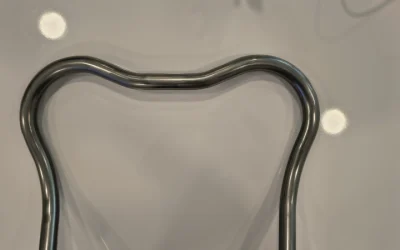
Bike exhaust manufacturers do not simply assemble components, they manage a technical process that integrates engineering, material processing, and deformation control. In motorcycle exhaust systems, every detail directly impacts performance, durability, and reliability.
Collector geometry, gas fluid dynamics, high-temperature resistance, and frame constraints must all be managed in a coordinated way. For this reason, contract bike exhaust manufacturing requires an engineering-driven approach that starts from the tube and evolves into the finished component, ensuring consistency throughout the entire production process. Read on to explore how this process is developed.
Bike exhaust manufacturing: why geometry matters more than welding
Bike exhaust manufacturers know that collector geometry has a greater impact than welding quality alone. Any discontinuity in the tube, such as joints or uncontrolled section changes, represents a potential critical point.
From a fluid dynamics perspective, welds introduce micro-irregularities that can generate turbulence in exhaust gas flow. This affects system efficiency and temperature management.
In addition, every joint is subject to thermal deformation due to heating and cooling cycles. Reducing the number of joints is essential, even in orbital tube welding processes, where precision and material continuity directly affect final quality.
This leads to improvements in:
- gas flow continuity;
- structural stability;
- component lifespan.
Hydroforming in motorcycle collectors: reducing joints and critical issues
To produce complex collectors while minimizing welds, bike exhaust manufacturers increasingly rely on hydroforming. This process uses high-pressure fluids to shape the tube, enabling advanced geometries without interrupting material continuity.
Compared to traditional bending with intermediate welds, hydroforming offers clear advantages:
- complex shapes produced in a single piece;
- structural continuity of the material;
- improved exhaust gas flow.
The result is a more reliable and higher-performing component, where geometry is optimized from the design stage. This approach is particularly effective in motorcycle exhaust collectors, where every curve directly influences system behavior.
Materials for motorcycle exhausts: why stainless steel is the industrial standard
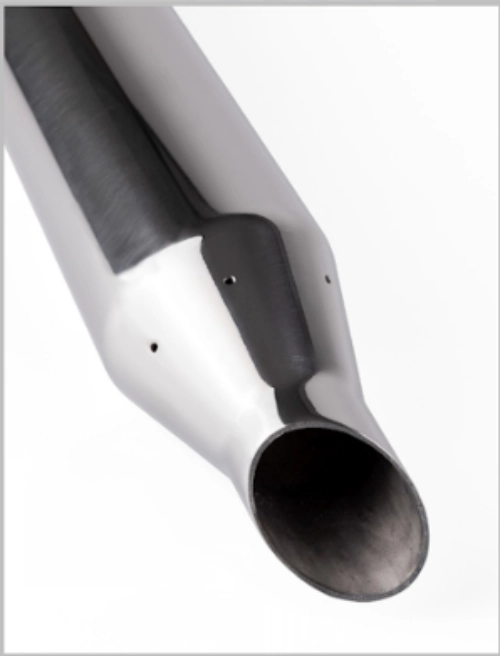
To ensure durability and long-term performance, bike exhaust manufacturers primarily use stainless steel. Stainless steel exhausts offer an optimal balance between mechanical performance and corrosion resistance.
Key properties include:
- high resistance to elevated temperatures;
- excellent corrosion resistance;
- long-term structural stability.
Compared to titanium, stainless steel is more workable and better suited for repeatable industrial production. Compared to carbon steel, it offers longer lifespan and lower maintenance.
For this reason, in industrial exhaust component manufacturing, stainless steel remains the most reliable choice when consistency and production continuity are required.
Tube processing for motorcycle exhausts: where quality is truly defined
Where is the critical point in bike exhaust manufacturing when processing tubes? Material deformation.
This is where geometric precision, tolerances, and final component quality are determined.
Main processing activities include laser tube cutting, CNC bending and precision machining for assembly fit-up.
During these operations, controlling material deformation is essential. Even minimal variations can compromise exhaust system alignment, leading to assembly issues.
Tolerance control is therefore crucial to ensure each component integrates perfectly into the final system.
How does contract bike exhaust manufacturing work?
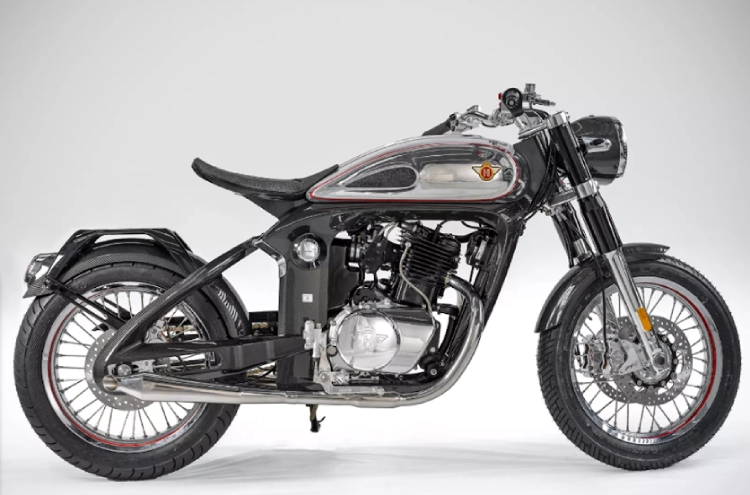
Contract bike exhaust manufacturing follows a structured process that integrates engineering and industrial production.
The service typically develops through five stages:
- Technical analysis of the component:
evaluation of operating conditions, geometric constraints, and materials - Geometry optimization:
reduction of joints and improvement of gas flow - Material selection:
choosing the most suitable alloy based on temperature and stress - Prototyping (if required):
technical validation before production - Serial production:
manufacturing with quality control and repeatability
This approach transforms a design requirement into an industrially scalable component.
Contract bike exhaust manufacturing: common challenges companies underestimate
Contract bike exhaust manufacturing involves several critical issues that often emerge only during production:
- post-weld deformation;
- out-of-spec tolerances;
- assembly problems;
- poor batch repeatability.
These issues often stem from design processes not aligned with manufacturing constraints. Without integrated control, even small errors can lead to rework and additional costs.
For this reason, it is essential to act upstream, designing components with production in mind.
The role of bike exhaust manufacturers in the industrial supply chain
Bike exhaust manufacturers operate within a complex supply chain involving design, processing, and final assembly.
Within this ecosystem, three main roles can be identified:
- OEM manufacturers (finished product);
- component suppliers;
- technology partners.
Ricos positions itself as a technical partner specialized in tubular component processing, supporting manufacturers in the most critical phases of the process.
This approach improves quality and reliability without directly producing the final exhaust system.
From tube to exhaust system: an integrated process
Bike exhaust manufacturing transforms a metal tube into a high-performance functional component.
Each phase must be consistent with the next:
- geometric design;
- tube processing;
- final assembly.
The quality of the exhaust system depends on the continuity of this process. Misalignments or errors in any single phase can compromise the entire component.
Why choose a technical partner for bike exhaust manufacturing
Bike exhaust manufacturing requires cross-functional expertise that combines engineering and production.
Relying on a technical partner like Ricos allows you to:
- reduce design errors;
- optimize production timelines;
- ensure consistent quality.
This approach enables the development of reliable components ready for integration into exhaust systems.
If your company develops exhaust systems or complex tubular components, bike exhaust manufacturing requires expertise that goes beyond simple tube processing.
Do you want to develop solutions designed to ensure precision, reliability, and production continuity?