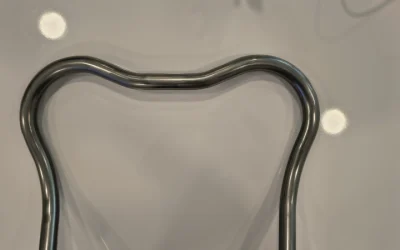
Square tubes obtained from round sections are becoming an increasingly popular solution across many industrial sectors where design, functionality, and production efficiency must coexist within the same component.
Think of technical lighting, metal furniture, automotive applications, or special industrial equipment: many projects require a tube with a round section in one area and a square section in another.
Traditionally, this result is achieved by manufacturing separate components that are subsequently assembled and welded together. While effective, this solution inevitably introduces additional costs, longer production times, and potential structural or aesthetic issues.
For this reason, more and more companies are looking for solutions that achieve the desired result while maintaining material continuity.
Why does the traditional method require cutting and welding?
Square tubes produced using traditional methods generally require the manufacture of two separate elements, one round and one square, which are then joined through welding.
This approach presents several limitations:
- increased production steps;
- additional machining operations;
- possible thermal deformation caused by welding;
- higher production costs;
- structural discontinuity points.
Furthermore, when the component must meet high aesthetic or dimensional standards, welds often require additional finishing operations to achieve a uniform surface.
Is it possible to obtain a square tube from a round tube without joints?
The answer is yes. Today, it is possible to produce square tubes starting from a round tube without using intermediate joints or welds, while progressively modifying the geometry without interrupting material continuity.
This approach completely eliminates intermediate joints and creates a monolithic component capable of maintaining uniform mechanical properties along its entire length.
The advantage goes beyond aesthetics. The absence of welds reduces the number of critical points that could generate localized stresses, deformation, or defects over time.
For high-precision applications, this difference can be decisive.
How can you transform a round tube into a square tube without welding?
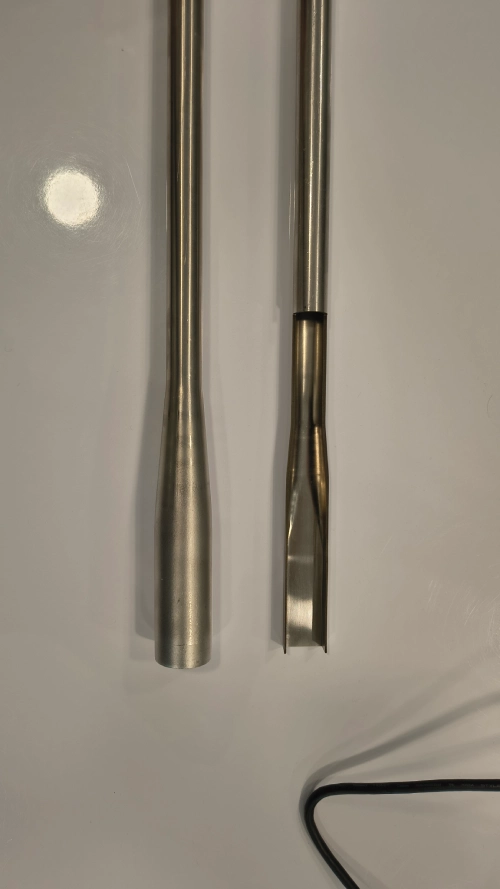
Square tubes without welds require advanced forming technologies capable of controlling material behavior throughout the entire production process.
In our case, the result is achieved through a proprietary technology developed in-house, allowing the tube sections to be progressively modified.
The process involves a controlled expansion phase followed by a gradual transformation of the geometry until the desired square section is achieved.
The most important aspect is that the tube maintains its structural continuity. No additional components are added, no welding operations are performed, and no discontinuities are created that could compromise the performance of the final part.
This ability to modify diameters and sections in a controlled manner makes it possible to create geometries that are normally considered extremely difficult to manufacture.
The technical challenge: maintaining deformation control
Transforming a round tube into a square tube is not simply a matter of changing the material’s shape. It requires extremely precise management of the stresses applied to the material.
During deformation, the tube is subjected to forces that can affect:
- wall thicknesses;
- final geometry;
- dimensional accuracy;
- surface quality.
To achieve a reliable result, it is essential to control stress distribution throughout the entire component.
The real technical challenge lies in guiding the deformation process so that the material flows correctly toward the new geometry without generating defects or irregularities.
For this reason, every project requires dedicated tooling and extensive knowledge of material behavior during processing.
Tube expansion and section transformation: how the process works
The transformation of metal tubes into square tubes at Ricos is based on a precise principle: progressively modifying the component geometry without interrupting material continuity.
The tube initially undergoes a controlled expansion process that redistributes the material in the areas affected by the transformation.
Subsequently, through tooling developed internally, the section is gradually modified until the desired shape is achieved.
This approach makes it possible to create components with different sections along the same tube, eliminating the assemblies and welds that would normally be required to achieve similar geometries.
Can you transform a round tube into a square one without damaging the surface?
One of the most significant advantages of weld-free square tubes is the quality of the final surface.
When multiple assembled components are used, welded areas often require finishing operations to eliminate visual and geometric discontinuities.
With controlled deformation, however, the material maintains much greater continuity.
This results in:
- improved aesthetic quality;
- fewer secondary operations;
- greater surface uniformity;
- better preservation of the original roughness.
In applications where the component remains visible or must meet high finishing standards, this advantage becomes particularly important.
Why eliminating welds can make a difference
The value of weld-free square tubes extends far beyond aesthetics.
Reducing or completely eliminating welds means:
- shorter production times;
- fewer rework operations;
- improved structural continuity;
- lower risk of localized defects;
- simplified manufacturing processes.
In many cases, it is possible to obtain a higher-performing component using fewer production steps.
This translates into tangible technical and economic benefits.
From geometry to the finished component: the role of engineering
Square tubes with variable geometries require an engineering approach that considers the entire production process.
The final geometry is not the result of a single operation but of the interaction between material, tooling, and forming technology.
For this reason, our work begins long before actual production starts.
We analyze the component, study its geometric challenges, and develop dedicated tooling capable of ensuring repeatability even in continuous production environments.
The objective is to create a stable, controlled, and fully industrialized process.
When proprietary technology opens new design possibilities
Square tubes produced through controlled deformation make it possible to completely rethink the design of many industrial components.
Geometries that would normally require multiple welded parts can instead be created from a single tube.
This means greater design freedom, lower production complexity, and improved final performance.
Our proprietary technology was developed with precisely this objective: offering new design opportunities while maintaining material continuity, surface quality, and geometric precision.
Do you have a project to develop?
If you operate in sectors such as:
- lighting;
- technical furniture;
- automotive;
- energy;
- industrial systems;
- special industrial components.
we can support you in developing tubular components designed to ensure precision, production continuity, and high-quality results.
Contact us to discuss your project and identify the most suitable solution for your specific requirements.