Lamp production for outdoor applications, especially in complex projects such as those developed for castaldi lighting italy, requires a precise balance between design vision and industrial feasibility. In collaborations with companies like Castaldi Lighting, the transition from concept to real component is never straightforward: complex shapes, continuous surfaces, and technical constraints require carefully engineered production choices.
In outdoor lighting, design cannot be separated from weather resistance, structural stability, and manufacturing quality. This is where product industrialization becomes essential: transforming an aesthetic concept into a manufacturable component while maintaining consistency between form, function, and process.
The Rosebud project: geometric complexity and advanced deformation
Lamp production in the Rosebud D75 project, developed for castaldi lighting italy, stands out for its high geometric complexity. Organic surfaces and fluid shapes require manufacturing processes that go beyond traditional techniques.
To achieve these geometries, it is necessary to work directly on the material through advanced deformation processes while maintaining precision and structural integrity. This means controlling every stage to avoid stress, unwanted deformations, or surface defects.
The result is a component that does not originate from multiple assemblies, but from a controlled transformation of the material itself, capable of meeting both aesthetic and functional requirements.
Integrated technologies: stamping, extrusion, and 3D laser processing
Stamping and component forming
Lamp production involving complex geometries, such as the projects developed for castaldi lighting italy, requires advanced stamping operations. The forming process makes it possible to achieve three-dimensional shapes while maintaining material stability and uniformity.
This stage is essential for defining the product structure and ensuring continuity and strength.
Extrusion for structural continuity
Extrusion plays a key role in lamp production because it allows material continuity to be maintained while reducing the need for joints.
This approach improves:
- structural quality;
- assembly precision;
- geometric consistency of the component.
Lavorazione laser 3D per assemblaggi complessi
Lamp production for high-quality applications requires precise and controlled welding, even though the real objective is to reduce the number of welds whenever possible.
In the Rosebud project, welding is not the dominant element, but rather a critical phase that must guarantee:
- aesthetic continuity;
- mechanical strength;
- long-term durability.
Controlling thermal deformation and ensuring high-quality surface finishing therefore become essential elements in achieving a reliable product consistent with the original design.
Welding and finishing: invisible but decisive quality
Lamp production for high-quality applications requires precise and controlled welding, even though the real objective is to reduce the number of welds whenever possible.
In the Rosebud project, welding is not the dominant element, but rather a critical phase that must guarantee:
- aesthetic continuity;
- mechanical strength;
- long-term durability.
Controlling thermal deformation and ensuring high-quality surface finishing therefore become essential elements in achieving a reliable product consistent with the original design.
Which materials are recommended for designer lamp production?
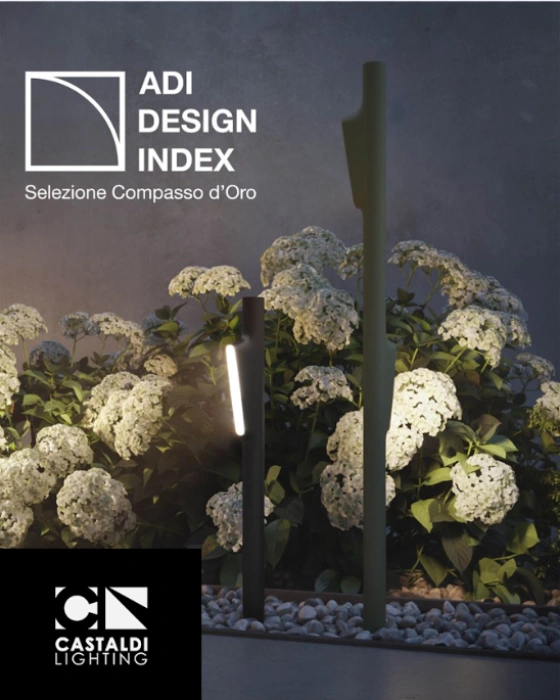
Lamp production for outdoor applications requires materials capable of guaranteeing high performance over time. Stainless steel is one of the most widely used solutions for outdoor applications.
Compared to other materials, it offers:
- high corrosion resistance;
- structural stability;
- durability even in critical environmental conditions.
In the collaboration with Castaldi Lighting, material selection was strictly linked to the need to maintain both aesthetic and functional integrity over the long term.
Outdoor lamp production: technical constraints to consider
When developing lamp production solutions for outdoor environments, such as projects created for castaldi lighting italy, several often underestimated technical constraints must be considered.
Among the main factors:
- exposure to rain and humidity;
- thermal expansion and temperature fluctuations;
- corrosive agents.
These elements directly affect:
- dimensional tolerances;
- required manufacturing processes;
- engineering decisions.
A properly designed component must maintain performance and quality over time without compromise.
The role of Ricos: transforming a concept into a real component
When developing complex projects related to lamp production for outdoor applications, having a partner capable of integrating engineering and manufacturing is essential.
Our company operates in the most critical stages of the process:
- material processing;
- controlled deformation;
- integration of manufacturing technologies.
The objective is not to manufacture the final product itself, but to develop the components that make the project possible while guaranteeing precision and production continuity.
From form to function: why the process makes the difference
Therefore, lamp production, even in advanced projects like the one discussed in this article, demonstrates how final quality depends on the entire manufacturing process.
Every stage, from initial deformation to final assembly, contributes to defining:
- component reliability;
- geometric precision;
- aesthetic quality.
An integrated approach makes it possible to reduce errors, optimize production times, and guarantee consistent results even in highly complex manufacturing projects.
Develop your project
Lamp production for outdoor applications is not just a matter of design, but the result of an advanced industrial process integrating materials, technologies, and expertise.
Projects such as the one developed with Castaldi Lighting demonstrate that the difference does not lie in a single production step, but in the ability to manage the entire manufacturing cycle consistently.
If you work in sectors such as:
- lighting;
- industrial design;
- automotive;
- energy;
- complex tubular components.
Would you like to develop solutions designed to guarantee precision, reliability, and production continuity?