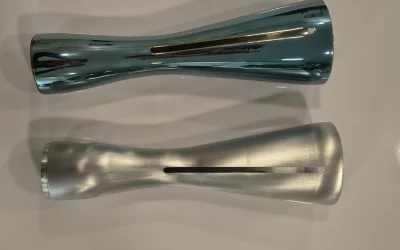
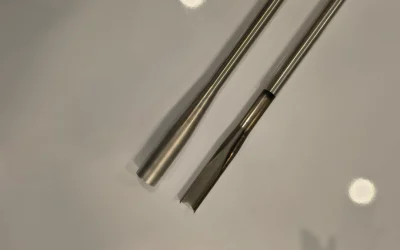
Bike frame manufacturing requires a precise balance between design, material processing, and deformation control.
In particular, machining aluminum tubes for bike frames represents one of the most delicate stages of the production process.
In the cycling industry, aluminum remains one of the most widely used materials for frame construction thanks to three main characteristics:
- low weight;
- good structural stiffness;
- relatively contained production costs.
However, machining aluminum tubes intended for frame construction involves several technical challenges. The most significant one concerns tube deformation during machining operations, which can compromise both the geometric accuracy and the performance of the final component.
In this article, we analyze how the manufacturing of tubular components for bike frames is approached, starting from the main technical challenges to the role of industrial design in controlling the production process.
Bike frame manufacturing: the main challenges in aluminum processing
Bicycle frames are lightweight structures but are subjected to significant stresses during use. For this reason, the aluminum tubes used in production must ensure mechanical strength, stiffness, and dimensional accuracy.
Typically, tubes used for bike frames feature:
- wall thickness between approximately 1.2 mm and 1.5 mm;
- variable diameters depending on the frame section;
- alloys designed to guarantee fatigue resistance.
The choice of alloy is the starting point: 6000 series alloys (such as 6061) and 7000 series alloys (such as 7005 or 7075) are the industry standard due to their excellent strength-to-weight ratio.
While the 6000 series offers great versatility and corrosion resistance, the 7000 series allows higher tensile strength to be achieved.
To maximize performance, manufacturers increasingly rely on hydroforming. This process uses high-pressure fluids to shape the tube from the inside against a mold, enabling complex shapes, variable cross-sections, and localized structural stiffness that would be impossible to achieve with traditional machining.
However, such advanced processes increase the complexity of managing residual stresses in the material.
At Ricos, we integrate knowledge of these alloys with precision laser cutting and controlled tube bending, ensuring that hydroformed components maintain the tolerances required during assembly.
These characteristics make aluminum ideal for the cycling industry, but at the same time they make it sensitive to deformation during machining.
During operations such as:
- tube bending;
- shaping processes;
- component joining.
phenomena such as the following may occur:
- cross-section ovalization;
- internal stresses in the material;
- loss of dimensional accuracy.
In bike frame manufacturing, therefore, the real objective is not simply to machine the tube, but to control the material’s behavior throughout the entire production process.
Why are bicycle frames made of aluminum?
Aluminum is one of the most widely used materials in bike frame manufacturing because it offers a good balance between lightness, stiffness, and production cost.
Compared with steel, it is lighter, while compared with carbon fiber it offers lower costs and more industrialized production processes.
For this reason, aluminum is widely used in road bikes, gravel bikes, and mountain bikes.
Tube machining for bike frames: how to prevent deformation
When machining an aluminum tube intended for a bike frame, every stage of the process must be carefully designed to minimize unwanted deformation.
The first step involves analyzing the raw material.
The alloy used, the tube thickness, and the diameter directly influence the behavior of the material during machining.
Next, the final geometry of the component is defined, considering:
- dimensional tolerances;
- potential variations during machining;
- the stresses the tube will experience within the frame.
The main operations involved in the process may include:
- cutting the tube to the required length;
- controlled bending;
- precision machining for structural joints.
During these operations it is essential to keep internal stresses under control, because even small deformations can affect frame alignment.
For this reason, machining tubes for bicycles often requires specific expertise in managing deformation in metallic materials.
Bike frame manufacturing: from tube to structural component

Transforming an aluminum tube into a structural component for a bike frame involves a production process that integrates industrial design and manufacturing.
The starting tube has a simple geometry, but during production it is progressively transformed into the shape required by the frame design.
Machining operations must follow very precise parameters, because even minimal dimensional variations can influence:
- frame alignment;
- stress distribution;
- the dynamic behavior of the bicycle.
For this reason, industrial machining processes dedicated to the cycling sector must integrate dimensional controls and quality checks throughout the entire process.
Only in this way is it possible to obtain reliable and durable components.
Bike frame manufacturing: differences between aluminum and carbon
In the bicycle market, the most widely used materials for frame manufacturing are aluminum and carbon fiber.
The choice of material influences not only the performance of the final product, but also the production process.
While carbon dominates high-end racing applications for maximum lightness, aluminum remains the standard for reliability and industrial scalability.
For a partner like Ricos, working with aluminum means offering high performance with reliable and repeatable manufacturing processes.
What are the best Italian companies for bike frame manufacturing?
Italy is one of the countries with the most consolidated traditions in bike frame manufacturing. Over the years, a specialized industrial supply chain has developed, consisting of companies focusing on different stages of production.
Among the most well-known Italian companies in the sector are:
- Faggin Bikes, a historic manufacturer of handcrafted frames;
- F.lli Bonetti, specialized in metal frame processing;
- Somec, an industrial group active in complex metal structures.
These companies represent different production approaches, ranging from artisan craftsmanship to industrial manufacturing.
Ricos’ positioning in bike frame component manufacturing
Within the bicycle frame supply chain, there is a fundamental role that is often less visible: that of industrial partners specialized in structural component manufacturing.
This is where Ricos’ expertise fits in.
Ricos specializes in industrial design and the machining of tubular metal components.
Rather than producing complete frames directly, we position ourselves as a technical partner for the development of complex components, providing specialized expertise in tube processing and material deformation management.
This approach allows us to support companies in the cycling sector during the most critical stages of production, especially when the following are required:
- high-precision tubular machining;
- deformation control during processing;
- optimization of the production process.
Thanks to these capabilities, Ricos integrates into the bike frame supply chain as a technology partner for structural component development, contributing to improved efficiency and quality in production processes.
How are bicycle frames manufactured?
The production of a bike frame involves several stages:
- frame geometry design;
- machining of metal tubes;
- component assembly;
- surface treatments and quality control.
Tube machining represents a critical stage because it determines the geometric precision and structural strength of the frame.
The industrial production process: from raw material to finished frame
Manufacturing an aluminum bike frame is not simply a sequence of tasks, but an integrated workflow that can be summarized in five key phases:
- Design and Industrialization (DFM): Frame geometry, tolerances, and structural stresses are defined. The Design for Manufacturing approach is essential to anticipate how the material will react during machining.
- Cutting and Preparation of Aluminum Tubes: precision laser cutting ensures that each component has the correct length and end profiles for joints (the so-called frame “nodes”).
- Advanced Forming and Shaping: through CNC bending or hydroforming, the tube takes on the aerodynamic or structural shapes required, while carefully managing internal material stresses.
- Assembly and Welding: joining components (usually via TIG or MIG welding) requires precise fixtures to ensure that the frame remains perfectly aligned.
- Heat Treatment and Quality Control: after welding, many aluminum frames (such as 6000 series alloys) require heat treatment to restore mechanical properties. This is followed by final metrological inspection to verify every millimetric dimension.
Ricos integrates into this workflow as a specialist in tube preparation and forming, providing frame manufacturers with intermediate components featuring extremely tight tolerances.
Industrial design in bike frame manufacturing
In bike frame manufacturing, transforming a raw tube into a high-performance structural component is never a simple mechanical execution.
The real challenge lies in the integration between the designer’s vision and the industrial reality of metal processing.
Accurate industrial design, based on the Design for Manufacturing (DFM) approach, makes it possible to:
- Predict material behavior by anticipating how 6000 and 7000 series alloys react to cutting and bending stresses;
- Reduce assembly costs by ensuring each component reaches the welding line with millimetric tolerances;
- Optimize dynamic performance by ensuring that geometric alignment and stress distribution match the design requirements.
In this scenario, the ability to manage tube deformation during machining becomes the key factor in obtaining a reliable and high-performance frame.
Ricos positions itself not only as a supplier, but as a technology partner capable of translating complex geometries into structural components ready for final assembly.
Ricos is ready to develop custom tubular components
If your company operates in the cycling industry or in other industrial sectors that require complex metal tube processing, the support of a specialized partner can make a real difference in both design and production.
The Ricos technical team supports companies in developing custom solutions for tubular and structural components.
Contact our technical team to develop custom tubular components and optimize your project’s production process!