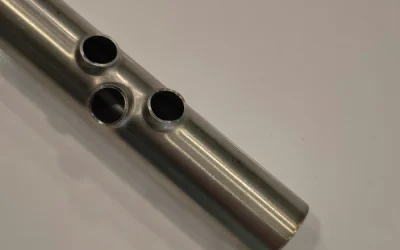
Supply chain traceability is now one of the most important elements in modern industrial manufacturing. In sectors where components must guarantee reliability, strength and safety, knowing the origin of materials and the production path of each individual part is not just good practice, it is a necessity.
Supply chain traceability makes it possible to accurately trace back the raw material, machining processes and assemblies that make up a final product. This becomes even more critical when producing components designed to operate under demanding conditions, such as fluid systems or manifolds working at high pressure.
In environments where a component may be subjected to pressures up to 300 bar, quality cannot be left to chance. A precise system is required to track the history of every element entering the production process and to ensure long-term control over the manufacturing history of each component.
Supply chain traceability: what it really means in industrial manufacturing
Industrial supply chain traceability is the process that makes it possible to reconstruct every production stage of a component, from raw material to final product.
In industrial environments, this process involves three main levels:
- raw material traceability;
- process traceability;
- final assembly traceability.
Each stage of the production process generates critical information: material batch, process parameters, production date, operators and machines involved.
Thanks to this system, it is possible to build a true technical identity of the component, a kind of industrial “identity card” that accompanies the part throughout its entire production cycle.
Not surprisingly, traceability is now widely used across advanced industrial sectors, including automotive, energy, oil & gas, fluid component manufacturing and high-pressure systems.
In these contexts, material and process traceability is a fundamental requirement for ensuring quality and safety.
Why supply chain traceability is important in industrial manufacturing
One of the most common questions in manufacturing is precisely this: why is supply chain traceability so important in industrial production?
The answer is simple: traceability allows companies to quickly identify the origin of potential defects, improve quality control, and ensure safety in components designed for critical applications.
A welded component, for example, is created by joining several elements: tubes, plates, fittings or machined parts assembled to form a complex system. In these cases, potential defects may not only affect a single part but may propagate throughout the entire system.
If a component shows a non-conformity, without a traceability system it becomes difficult to determine:
- which material batch the part originated from;
- which other components were produced from the same material;
- in which final products those components were used.
The ability to reconstruct the product genealogy, the complete history of every component, makes it possible to intervene quickly and precisely.
How traceability of metal components works
Another common question concerns the operational side: how is traceability ensured for metal components?
Traceability of metal components is achieved through a combination of tools and procedures:
- material batch management;
- recording of manufacturing processes;
- component identification through permanent marking.
This system makes it possible to maintain the connection between raw material – semi-finished product – finished component – final product.
At Ricos, traceability is not an optional feature but part of the DNA of our production process. Process control begins with raw material management and continues throughout every production phase: tube processing, cutting, bending, machining and assembly.
Thanks to this approach, it is possible to continuously monitor the production flow, ensuring that each component remains linked to the technical information defining its origin and processing history.
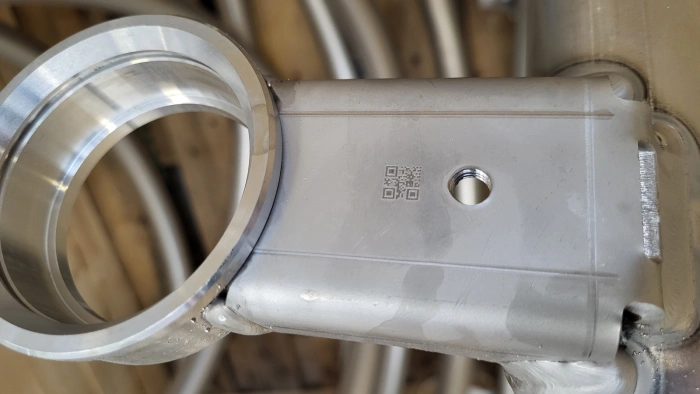
Laser marking of components: the first step of traceability
One of the most effective tools for ensuring supply chain traceability is laser marking.
At Ricos, each element can be identified through codes engraved directly onto the metal via laser marking. These codes allow the component to be connected to all the information recorded within the production process.
Through this system it is possible to quickly trace:
- material batch;
- production stage;
- machining date;
- related order or project.
A particularly important aspect is that laser marking does not alter the mechanical properties of the component. This means the identification process does not compromise the material’s strength, structure or performance, a crucial factor for components designed to operate in critical environments or under high pressure.
The result is a system that guarantees permanent part identification without interfering with its technical characteristics.
The challenge of semi-finished products in storage
One of the most complex aspects of managing supply chain traceability concerns semi-finished products.
During production, many intermediate components are temporarily stored in warehouses before being used in subsequent machining or assembly stages. If these semi-finished products are not correctly identified, the connection to the original raw material may be lost.
To avoid this issue, traceability must begin from the earliest stages of production.
Marking initial components and managing material batches makes it possible to maintain the link between:
- raw material;
- semi-finished component;
- finished component.
This approach ensures information continuity throughout the entire production chain and allows companies to maintain full control over the production history of components over time.
From raw material to finished manifold: a practical example
To better understand the value of supply chain traceability, let us consider a practical example.
A batch of raw material is used to produce a series of components intended for the manufacturing of industrial manifolds. Each element is processed, marked and recorded within the production system.
Later, these components are welded and assembled into the final manifolds.
If an issue arises over time with one of the parts, the traceability system makes it possible to:
- identify the material batch it originated from;
- locate all components produced from the same material;
- verify in which manifolds those components were installed.
This level of control allows companies to intervene quickly and precisely, reducing both risks and investigation time.
Supply chain traceability and industrial system safety
When designing components intended to operate in demanding conditions, supply chain traceability also becomes a safety factor.
Consider, for example, fluid systems or pressure vessels. In such cases, each element must guarantee strength, sealing and long-term reliability.
The ability to trace the origin of every component makes it possible to verify material quality, control performed processes and reconstruct potential production anomalies.
In other words, traceability is not only useful for managing potential issues, but also represents a fundamental tool for preventing them and improving production process control.
Traceability as part of the project
At Ricos, supply chain traceability is not seen merely as a technical or regulatory requirement.
It is an integral part of how components are designed and manufactured.
Integrating traceability into the production process means building a system where each phase is connected to the next, ensuring information continuity and technical control.
This approach allows us to offer customers not only industrial components, but also reliable, transparent and verifiable production processes.
If your company works with welded components, fluid systems or pressure applications, supply chain traceability can make a real difference in quality and safety management.
Contact our team to develop solutions designed with a controlled and fully traceable production process!