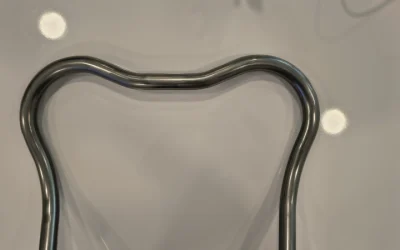
Choosing the pipe bending radius is one of the most critical aspects in the design of bent metal components, as it directly affects mechanical performance, functional integration, and the sustainability of the production process.
In CNC tube bending, opting for a fixed radius or a variable radius is not a neutral decision: it determines the level of precision, flexibility, and geometric complexity the component can achieve. Understanding the differences between these two solutions helps avoid unnecessary compromises and turns a technical constraint into a true design advantage.
In this article, we analyze how to choose between fixed and variable bending radius solutions, comparing technical limits, application benefits, and the scenarios in which the expertise of a specialized partner like Ricos makes a tangible difference.
Pipe bending radius: what it is and why it is a critical parameter

In tube bending processes, the pipe bending radius represents the distance between the theoretical center of the curve and the tube axis during plastic deformation. This parameter directly influences stress distribution, cross-section stability, and the final geometric quality of the component.
A pipe bending radius that is too tight can cause ovalization, wall thinning, or micro-collapse of the material; conversely, an excessively large radius may compromise spatial constraints and the functional integration of the component within the final system. For this reason, the bending radius is often expressed as a multiple of the tube diameter (xD), a technical reference commonly used during preliminary design.
In advanced CNC operations, the bending radius is no longer just a geometric value but a parameter integrated into machine programming. It affects tooling, production cycles, dimensional inspections, and long-term repeatability. This is where the expertise of a partner who works on the coherence between design and process becomes essential.
Fixed-radius bending: precision, repeatability, and geometric control
When discussing a fixed pipe bending radius, we refer to a solution where the tube is bent with a constant radius along the entire geometry, using dedicated tooling calibrated for a specific diameter and radius.
This technology is particularly suitable when the project requires high geometric precision and tight tolerances. Fixed-radius bending ensures excellent repeatability, making it ideal for serial production or components that must integrate into complex assemblies without margin for error.
Another advantage is the possibility of achieving very tight radii, even below 1xØ of the tube diameter, which is essential in compact or high-density applications. However, production rigidity is the main limitation: each change in radius requires a new tooling setup, and in most cases the bending angle is limited to 180°.
For this reason, fixed-radius bending is an effective choice when the design is consolidated, production volumes are stable, and the geometry does not require future evolution.
Variable-radius bending: design flexibility and advanced geometries
Within CNC tube bending, variable pipe bending radius technology represents a more advanced solution, designed to meet complex and non-standard design requirements.
In this case, the radius can vary along the tube development, allowing the creation of continuous curves, smooth transitions, and complex geometries using a single tooling setup. This approach drastically reduces design constraints and opens new possibilities in functional engineering.
One key advantage is the absence of structural limits such as 180°, enabling three-dimensional bends and spiral shapes. Variable radius bending is therefore ideal in applications where space constraints, fluid dynamics, or technical aesthetics play a central role.
From a technical standpoint, the minimum achievable average radius is typically around 5xØ of the tube diameter. However, thanks to advanced CNC technologies and precise process control, Ricos can reach radii as low as 3xØ, significantly expanding application possibilities compared to standard market capabilities. The trade-off involves less rigid radius control compared to fixed bending and requires high-level expertise during programming and validation.
Fixed vs variable bending radius: a technical comparison

When evaluating the appropriate pipe bending radius, the comparison between fixed and variable solutions should be approached from a functional, not ideological, perspective.
Fixed radius offers:
- High geometric precision;
- Excellent repeatability;
- Very tight achievable radii;
- Greater production rigidity.
Variable radius provides:
- Maximum design freedom;
- Continuous and complex geometries;
- Reduced tooling requirements;
- Greater adaptability to evolving designs.
The choice depends on factors such as production volumes, required tolerances, component complexity, and system integration. In many cases, there is no universally “better” solution, only the one most consistent with the industrial objective and product life cycle.
When CNC flexibility becomes a concrete advantage
The pipe bending radius becomes strategically relevant when the component is not merely structural but an active part of a complex system. Industrial plants, automotive applications, special machinery, and custom solutions often require bends that adapt precisely to available space and functional constraints.
In these contexts, variable radius bending can reduce joints, welds, and additional fittings, improving reliability, strength, and design cleanliness. CNC flexibility also allows rapid implementation of design changes without disrupting the entire production process.
The true value lies not only in the technology itself, but in the ability to interpret the design, identify critical points, and translate them into a technically sustainable bending solution.
Technical consultancy on pipe bending radius: the Ricos approach
Choosing the correct pipe bending radius should never be left solely to the production phase. A consultancy-driven approach allows feasibility, limits, and opportunities to be evaluated from the earliest design stages.
Ricos supports designers and industrial companies in defining the most suitable radius by analyzing materials, diameters, wall thicknesses, functional requirements, and application constraints. This method reduces rework, optimizes costs, and improves overall component quality.
Our consultancy does not stop at manufacturing; it integrates design support, simulation, and industrialization. In this way, the bending radius becomes not a constraint but a conscious and strategic design lever.
Ricos in the Italian CNC tube bending landscape
Within the Italian CNC tube bending sector, companies operate with very different approaches: some focus on high-volume standardized production, others on highly customized special applications.
Ricos positions itself in the high technical value segment, where precision, flexibility, and process integration are central. The ability to manage both fixed and variable radii, combined with strong technical support, allows us to meet complex design requirements without compromising quality.
It is not simply about producing bent tubes, but about ensuring that every radius is fully aligned with the final application and required performance.
Conclusion: bending radius as a strategic decision
The pipe bending radius is a key decision in the design of industrial components. Choosing between fixed and variable radius solutions impacts performance, cost, flexibility, and long-term reliability.
Understanding the limits and potential of both options allows engineers to design more efficient components that integrate seamlessly into production processes. Partnering with an experienced company transforms a technical choice into a real competitive advantage.
Discover Ricos tube bending services and work with a team capable of guiding you toward the most suitable bending radius for your project.