Modern metal fabrication has been revolutionized by a technology that combines speed and precision: laser cutting. This technique has made possible the realization of geometries on tubes and beyond that were previously unimaginable, drastically improving production efficiency. But what actually happens inside a laser cutting machine?
The laser cutting process is based on a high-precision, digitally controlled thermal process, essential for the production efficiency of all industries. Understanding its mechanisms means not just knowing the machine, but grasping the technology behind a perfectly cut component. In this article, we will reveal the laser cutting process step by step, focusing particularly on how laser cutting works for tubes, which is a core expertise of our company.
What is laser cutting?
Laser cutting involves using a focused laser beam to cut or carve materials in two or three dimensions, often via multi-axis (up to 5-axis) machines. With this method, you can achieve complex profiles that vary along the surface or in space, not just on flat planes.
Advantages of Using CAD/CAM Files
For many applications, the laser operates using CAD/CAM files, moving the beam or the machine axis to follow 3D shapes. This eliminates the need for traditional molds or bending/cavitation tools. Here are the key advantages:
- Elimination of Molds: There is no need to create dedicated molds or jigs for every geometry. You can go directly from a CAD model to a cut piece.
- Rapid Prototyping: Transitioning from design to fabrication happens very quickly, significantly reducing development cycles.
- Low-Cost Customization: It is easy to produce different parts without additional tooling costs, making it ideal for small batches or unique pieces.
- Evolutionary Flexibility: Design modifications translate into immediate digital changes, without the high cost and downtime of redesigning molds.
- Multiple Complex Operations in a Single Pass: Multiple operations are performed at once, eliminating the need for repeated setups on dedicated molds.
What’s behind the laser cutting process?
The effectiveness of industrial laser cutting stems from its unique properties: the light is extremely concentrated, monochromatic, and coherent (meaning the waves travel in phase).
The heart of the modern Laser Cutting Process for metalworking is the fiber generator. These generators offer high energy efficiency, superior cutting speed, and reduced maintenance. They are ideal for performing laser cutting on tubes, profiles, and thin-to-medium thickness sheets, successfully processing materials like stainless steel, carbon steel, and aluminum.
Once generated, the beam must be guided: the transport system, carried out via fiber optics, takes the energy to the cutting head. Here, a system of lenses and mirrors plays the crucial role of focusing the beam. The energy is concentrated into a tiny focal point (spot) (often less than a millimeter), reaching an energy density sufficient to instantly melt the metal. This concentration is the true key to the Laser Cutting Process and its micrometric precision.
How laser cutting works: the cutting sequence

The actual cutting process is a controlled sequence of physical events:
The thermal process
When the concentrated laser beam hits the metal surface, light energy is absorbed and converted into heat. The material’s temperature rises instantaneously, surpassing its melting point or, in some cases, its vaporization point.
The critical role of assist gas
The gas is not merely an auxiliary element but an integral part of how laser cutting works. It is blown coaxially to the laser beam, performing two main functions:
- Protection: It prevents the laser beam and lenses from being contaminated by molten material or vapors.
- Material Removal: It pushes the molten material out of the cutting kerf.
The choice of gas depends on the material:
- Nitrogen (Fusion Cutting): Used for materials like stainless steel and aluminum. The gas is inert and solely serves to expel the molten material, ensuring a clean and, crucially, non-oxidized cut, which is fundamental for subsequent welding phases.
- Oxygen (Flame Cutting): Used for carbon steel. The gas actively participates in an exothermic reaction (controlled combustion) that increases the thermal energy, making the Laser Cutting Process faster and more effective, especially on greater thicknesses.
3D laser cutting on tubes and profiles
While the Laser Cutting Process is efficient on flat sheets, it becomes revolutionary on tubes and profiles. This is known as 3D Laser Cutting.
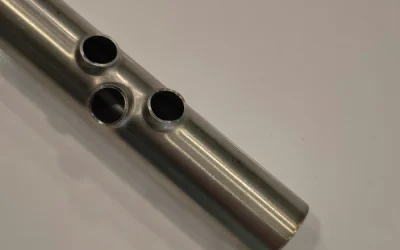
Unlike 2D cutting, specialized tube machines operate on multiple axes simultaneously (multi-axis). The tube is clamped and continuously rotated, while the cutting head moves longitudinally and radially. This allows for complex geometries, bevels, and inclined cuts on the curved surface of the tube.
This advanced Laser Cutting Process on tubes has an unbeatable strategic advantage: it eliminates secondary operations. A component that previously required drilling, sawing, milling, and perhaps further cleaning is completed in a single, automated operation.
Application Examples of 3D Laser Cutting:
- Interlocking Joints
- Inclined Cuts and Bevels
- Slotted Holes and Slots
Determining factors for quality

To ensure that the Laser Cutting Process results in a perfect final component, several operational parameters must be mastered:
Power and speed
The operator must balance the laser power (Watts) with the cutting speed. A speed too high relative to the power can leave slag or rough edges, while a speed too low wastes energy and can deform the material.
Focus precision
The micrometric adjustment of the focal point is crucial. If the focus is too high or too low, energy disperses, and the cutting kerf widens, compromising dimensional accuracy.
The role of CNC
The software is the “brain” of the Laser Cutting Process. It manages the beam’s path and optimizes nesting (the arrangement of parts on the tube or sheet) to minimize waste, directly contributing to cost reduction.
Technical expertise
These advanced machines require the experience of a qualified technician to set the correct parameters for every metal alloy (copper, stainless steel, carbon, aluminum) and every thickness, ensuring maximum quality from the very first cut.
How can laser cutting improve your production?
Mastering the Laser Cutting Process, particularly on the complex 3D geometries of tubes and profiles, is the key to unlocking the highest levels of precision and efficiency in production. This technology is an integrated system that, when controlled by experts, is capable of radically transforming the component value chain, eliminating the costs and constraints of traditional molds.
Contact us: we will discuss your projects and how laser cutting works to apply precision laser cutting techniques to your tubes and profiles.