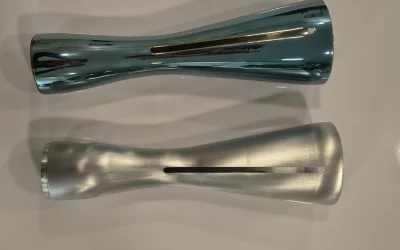
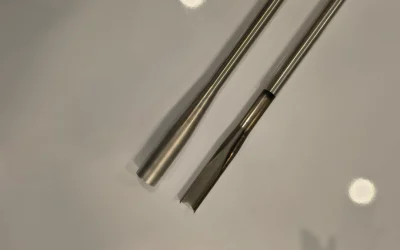
Not all welds are the same. If your company and project require durable, high-seal welding, there is only one choice: ISO welding certification, or rather, a certified welding process. This ensures strength, safety, and quality by employing qualified operators and standardized procedures.
But what exactly does certified welding mean, and why is it crucial for manifolds? Let’s explore it together.
Understanding Welding: the most common techniques

The most widely used welding techniques for manifolds (and beyond) are primarily two: TIG and MIG/MAG.
TIG Welding
TIG (Tungsten Inert Gas) welding is a process that uses a tungsten electrode to generate an electric arc and an inert gas (such as argon or helium) to protect the welding area from oxidation. This technique offers:
- High precision and superior finish quality
- Greater control over the molten pool
- Strength and performance on thin materials and lightweight alloys
MIG/MAG Welding
MIG/MAG (Metal Inert Gas/Metal Active Gas) welding uses a continuous wire as an electrode and a shielding gas (typically argon, CO₂, or a mix of both). The main advantages include:
- Faster execution compared to TIG welding
- Better performance on thicker materials
- Easier automation
What’s the difference between certified and non-certified welding?

A certified weld is performed by a qualified operator who has obtained a welding certification after specific training. This ensures that the welder applies the correct techniques to create safe and durable joints.
Additionally, certified welding processes follow strict regulatory standards and are often subject to additional inspections, such as seal tests and structural verifications.
In contrast, non-certified welding can present:
- Lower strength and durability over time
- Higher risk of defects, such as porosity or cracks
- Non-compliance with required standards in regulated industries
Types of welding certifications
Several certifications ensure the quality and reliability of welding processes:
- EN ISO 9601 Certification: Ensures that the welding process complies with European regulatory standards.
- WPQR and WPS Certifications (EN ISO 15614 and EN ISO 1509): Establish specific process guidelines and compliance with standards such as PED (Directive 2014/68/EU) and TPED (Directive 2010/35/EU).
Our company guarantees both certifications.
The evolution of welding: welding fixtures
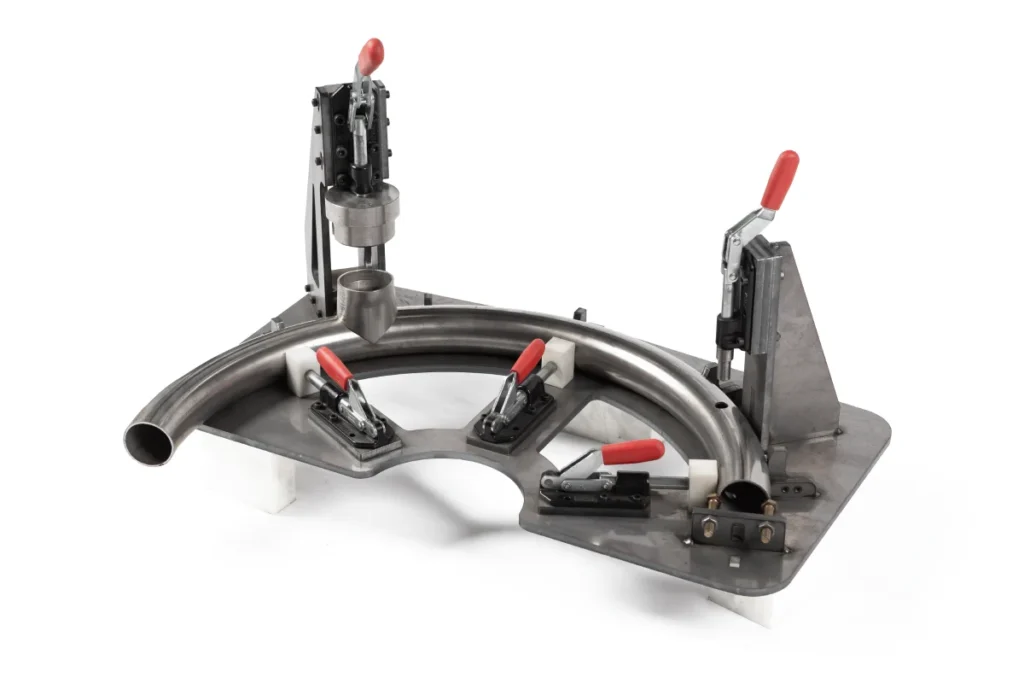

Welding fixtures, or jigs, are essential tools for ensuring precision and uniformity in welding processes. These custom-designed metal structures hold components in place, minimizing errors and improving weld quality. They speed up work, enhance repeatability, and optimize production—especially in automated or robotic processes—ensuring consistent results that meet certification standards.
There are two main types of welding fixtures: dedicated and modular.
Dedicated Fixtures
As mentioned, welding fixtures are tools used to position and secure components during welding. Dedicated, customized fixtures are designed for a single product or product family, ensuring high precision and repeatability.
Advantages of dedicated fixtures:
- Always correct positioning of pieces during welding
- Reduced setup time
- Consistent weld joint quality
- Ability to integrate specific welding techniques (e.g., multiple passes, torch angles, custom sequences)
Modular Fixtures
These fixtures offer flexibility and adaptability for different products, making them ideal for prototyping or low-volume production. However, they require more preparation time than dedicated fixtures and may lead to variations in piece quality. Nonetheless, they are perfect for repetitive articles where productivity and consistent quality are a priority.
A step further: robotic welding cells
Welding has significantly advanced with the introduction of robotics. Welding automation ensures greater efficiency and precision, reducing human errors and improving final product quality. Let’s explore the five key benefits of robotic welding.
- Optimal path along the weld joint: Welding robots precisely follow the weld joint path, ensuring uniformity throughout the weld. This reduces the risk of imperfections and enhances overall quality.
- Optimized machine data parameterization: Advanced control systems monitor and correct any anomalies in real time during welding. This guarantees perfect repeatability and minimizes waste.
- Long-term repeatability: As previously mentioned, automation ensures identical welds on multiple pieces, eliminating human error variations and ensuring consistent production over time.
- Safety and sustainability: Robotics reduces risks for operators, who no longer need to perform hazardous manual tasks. Additionally, a controlled process minimizes material waste, contributing to environmental sustainability.
- More time for quality control and calibration: With robots handling welding, specialized operators can focus on quality control and machine calibration, ensuring even higher standards.
Leak Testing: a critical step for certain applications

When it comes to manifolds, leak-proof sealing is an essential requirement. Therefore, in addition to performing ISO welding certification, it is crucial to subject the component to hydraulic pressure tests. Let’s explore this process in detail.
Why perform a leak test?
Pressure leak tests verify that all welds have been correctly executed and that the component can withstand working pressure without leaks. This provides an additional guarantee beyond welder qualification by testing the actual strength of the finished product.
How do hydraulic tests work?
The test involves applying a specific pressure inside the manifold and monitoring any variations. Generally, a test is conducted with pressure exceeding the operating level (e.g., 1.5 times the working pressure) to ensure safety even in extreme conditions.
When are hydraulic tests required?
- When industry regulations mandate them (e.g., in industrial or automotive sectors)
- When the manifold must withstand particularly high pressures
The real advantage? Choosing a partner that performs both certified welding and leak testing
Ensuring that the component is perfectly sealed is even more important if welding quality is crucial. Partnering with a company that provides both ISO welding certification and hydraulic pressure testing means obtaining a safer product that complies with regulations and is ready for use.
If you’re looking for a partner who can save you time with both certified welders and hydraulic testing specialists, contact us or discover our welding services!