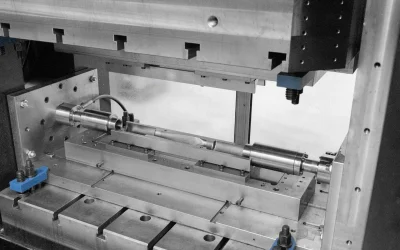
Tube expanding and reducing makes it possible to progressively reduce the diameter of a component while maintaining material continuity. In many projects, this provides a specific advantage: achieving a change in cross-section without having to cut the tube, add a second component, and create a welded joint.
Reducing the diameter, however, also means forcing the material to redistribute itself within an increasingly smaller space. When deformation becomes significant, critical issues may arise, especially on the internal surface.
The question is therefore not simply “how much can we reduce the tube?”, but rather: how far can deformation go while remaining compatible with the function, geometry, and requirements of the finished component?
The Limit of Tube Expanding and Reducing Does Not Depend Only on the Final Diameter
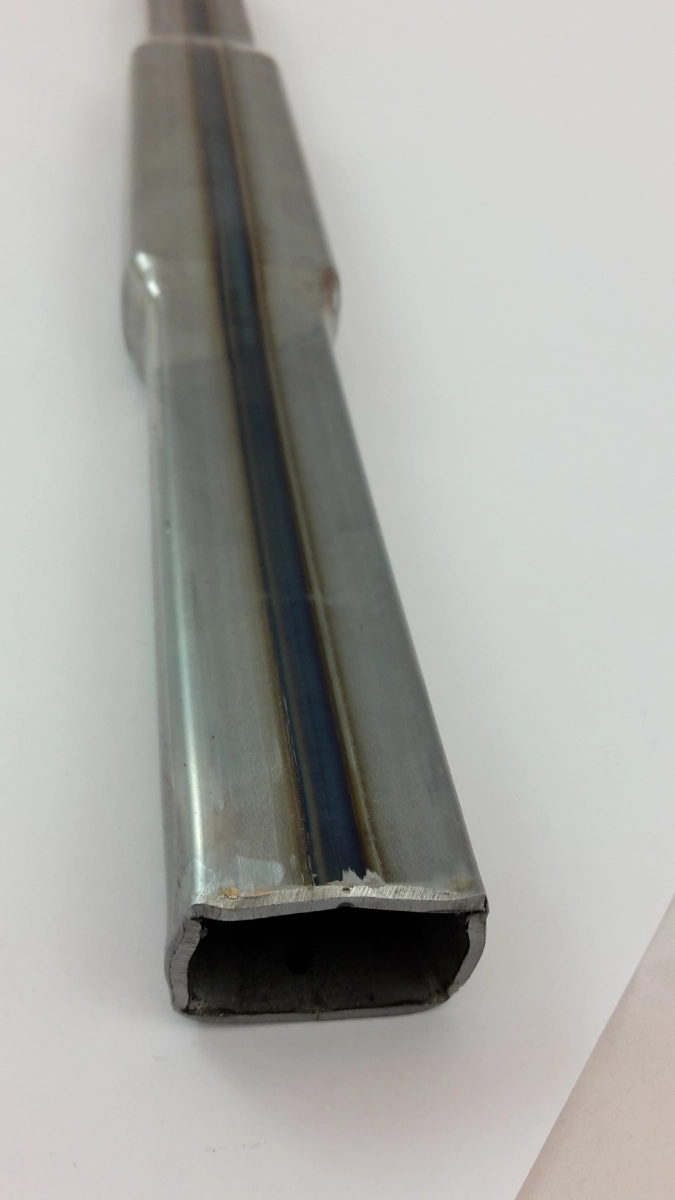
In tube expanding and reducing, the difference between the initial and final diameters is only one of the factors that determine feasibility.
Several aspects must be considered at the same time:
- wall thickness;
- material;
- ductility;
- material supply condition;
- length of the tapered section;
- degree of reduction.
The geometry of the tooling and the way the material is guided during deformation also influence the result.
Two tubes with the same diameter can therefore behave very differently if the alloy or wall thickness changes.
For this reason, there is no universal reduction percentage that applies to every component. The limit must be assessed on the actual project and, where necessary, verified through testing and sampling.
What Happens to the Material When the Diameter Is Reduced?
During tube expanding and reducing, material is not removed; it is deformed so that it occupies a smaller circumference.
This causes compression of the wall, which must redistribute itself along the new geometry. As long as deformation remains stable, the tube progressively takes on the required profile. When compression becomes excessive, however, the material may begin to accumulate and lose stability.
At this stage, wrinkles, waviness, or other irregularities may appear, particularly on the internal surface of the reduced section.
Their occurrence depends on the combination of material, wall thickness, required reduction, length of the taper, and process characteristics.
Tapering must therefore be designed by considering not only the external geometry, but also what happens inside the component.
Why Do Wrinkles Form Inside the Tube?
In tube expanding and reducing, internal wrinkles are a possible consequence of material compression and do not necessarily mean that the process has been carried out incorrectly.
When the diameter is reduced, a given amount of material must redistribute itself over a smaller surface. If the wall cannot accommodate this change uniformly, it may lose stability and form localized folds.
The phenomenon tends to become more critical as the reduction ratio increases, or when geometry, wall thickness, and the mechanical properties of the material make wall flow more difficult to control.
The process limit therefore results from the balance between the shape to be achieved and the ability of the tube to reach that geometry while maintaining characteristics compatible with its final application.
Is an Internal Wrinkle Always a Problem?
In tube expanding and reducing, the presence of an internal irregularity must be evaluated according to the function of the component.
A surface that is not perfectly uniform may have limited importance in certain structural applications. The situation changes completely when the tube is intended to carry fluids or must meet specific requirements for cleanability, flow, or surface roughness.
In these cases, a wrinkle may create stagnation areas, alter the usable cross-section, or make the internal surface incompatible with the required specifications.
This is the same principle we discussed in relation to low tube surface roughness: internal surface quality should not be assessed only visually, but according to the application and the required performance.
When Is Internal Tube Machining Necessary?
After tube expanding and reducing, when internal wrinkles are incompatible with the required function, a dedicated operation on the internal surface may be necessary.
The objective is to remove or smooth out the irregularities created during compression, bringing the deformed area back to a condition compatible with the project requirements.
The type of intervention must be defined by considering the available internal diameter, length of the reduced section, accessibility, amount of material to be removed, and required final characteristics.
This stage should not be treated as an improvised correction at the end of the process. If the reduction is expected to generate internal irregularities, the subsequent internal machining operation should also be considered during the feasibility analysis.
In this way, tapering and internal finishing become two coordinated stages of the same production process.
Why Reduce the Tube Instead of Welding Two Components?
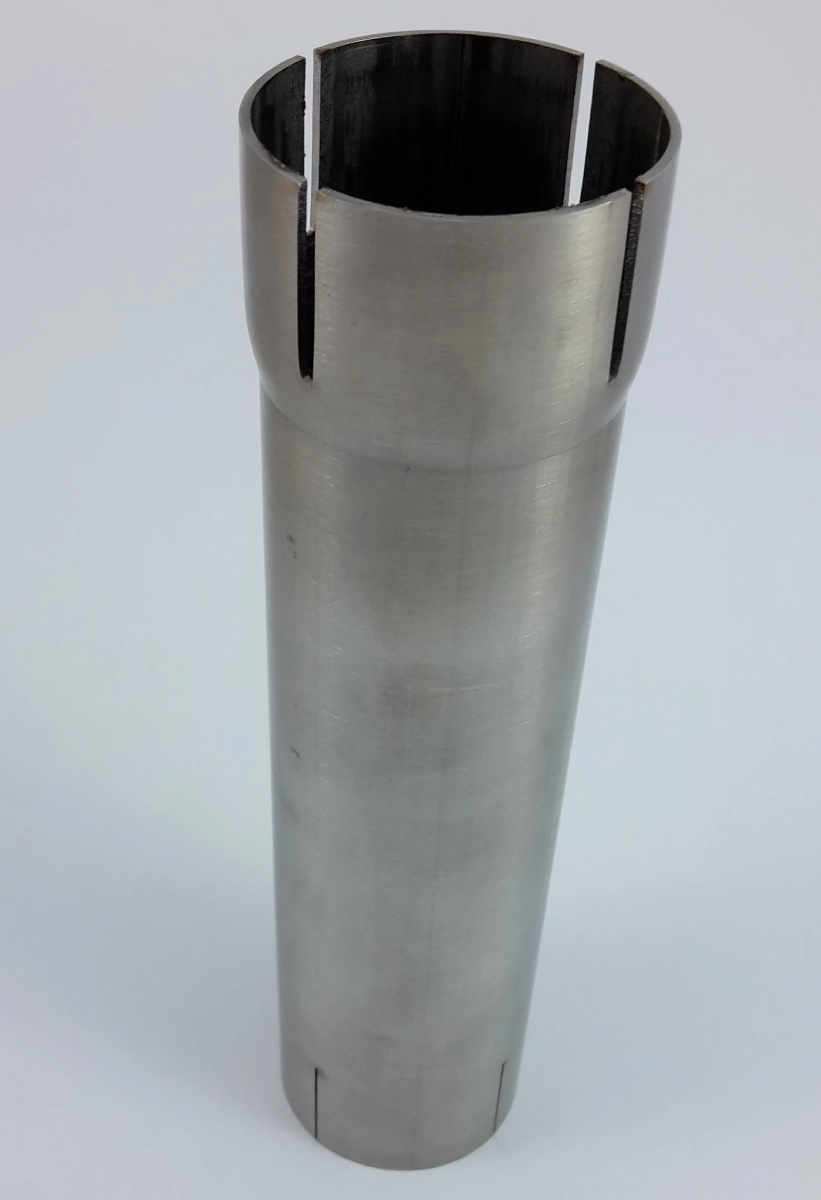
One of the most interesting advantages of tube expanding and reducing is the possibility, when geometry allows it, of avoiding a solution made up of multiple components.
Without tapering, achieving two different diameters could require cutting the tube, manufacturing or purchasing a second component, positioning the parts, and then welding them together.
With tube reducing, however, the component can remain continuous.
This can mean fewer operations, fewer joints, and greater geometric continuity of the component.
Avoiding welding, however, should not become an absolute objective. If the required reduction produces deformation that is difficult to control or requires excessively complex subsequent operations, the two solutions must be compared to determine which is genuinely more sustainable.
When Is Tube Expanding and Reducing Not the Right Solution?
Tube expanding and reducing should be reconsidered when the combination of material, wall thickness, and required reduction makes it difficult to maintain stable deformation.
Low-ductility materials, very significant reductions, short and aggressive geometries, or particularly strict requirements for the internal surface can make the process more complex.
Accessibility is also essential. If wrinkles need to be removed but the internal area cannot be reached effectively, the solution may not be industrially cost-effective.
Feasibility therefore depends not only on whether the shape can physically be produced, but also on whether it can be manufactured with repeatable quality, sustainable production times, and compatible subsequent operations.
Tube Expanding and Reducing: The Limit Is Defined by the Actual Component
At Ricos, tube expanding and reducing is assessed by considering the initial and final diameters, material, wall thickness, geometry, internal surface characteristics, and function of the component.
Our goal is not to push the reduction to the machine’s absolute limit, but to identify a solution that can be transformed into a stable and industrially viable process.
When necessary, tapering can be integrated with internal machining, laser cutting, forming, welding, or other machining operations, defining the production sequence according to the required final result.
Do you have a component that needs to be tapered, or would you like to understand whether a diameter reduction could replace a welded solution?
Discover our tube tapering service and contact us to assess the geometry, material, and feasibility of your project together.