In an increasingly automated industrial world, having sensors that operate with extreme precision is fundamental. From measuring temperatures in industrial ovens to monitoring pressure in hydraulic systems, every single data point is crucial for ensuring process efficiency and safety. But what happens when these precision instruments are exposed to hostile environments? How are they protected from heat, vibrations, high pressure, or chemical agents?
The solution lies in protective tubes, essential elements that act as a physical shield for sensors. While thermowells are among the most well-known applications of these components, specific industry needs often require solutions that go far beyond standard offerings. The choice of a protective tube is never random; it must be a perfect fit for the environment and the sensor’s specifications to guarantee maximum reliability. Read on to learn more.
Protective tubes: a key element for sensor reliability
Engineered protective tubes serve a dual, crucial function: they shield sensors from physical and chemical damage while simultaneously ensuring their proper operation. Without an adequate shield, a sensor could suffer irreversible damage, with significant consequences for production.
However, a simple, standard tube is often not enough. Ready-made solutions, though easy to find and more economical, have clear limitations in terms of adaptability, strength, and sealing. The geometry and tolerances of a standard tube may not perfectly match the needs of a specific system, causing installation problems or, worse, compromising sensor protection.
This can lead to a sudden halt in production, with significant economic losses and risks to worker safety. Furthermore, the need to frequently replace sensors increases maintenance costs and slows down production processes. Investing in custom protective tubes is, therefore, a truly strategic choice for any effective sensors housing plan.
Beyond standard thermowells: the advantage of seamless swaging
When we think of protective tubes, the first image that comes to mind is often the classic thermowell, used to house temperature probes. However, even in manufacturing these components, traditional processing techniques can create weak points. Many standard thermowells and other protective tubes are made with welds that can compromise the material’s integrity, creating internal stresses or more fragile zones.
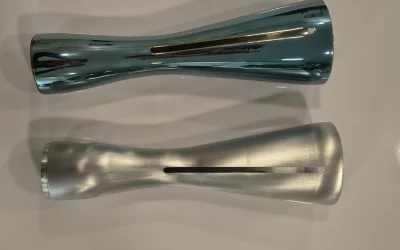
The solution to these problems is swaging, a process that is establishing itself for creating robust and reliable sensors housing. Swaging is a process that allows for modifying the shape of a tube at a specific point without the use of welding or additional materials. The result? A component that ensures greater resistance to stress. This translates into more robust protective tubes, capable of withstanding extreme pressures and temperatures without deformation or breakage.
Unlike welding, swaging does not introduce weak points or structural alterations. This allows for superior protection for sensors and an unmatched peace of mind for the operator.
Direct threading: maximum precision and fewer breakages

Another fundamental aspect that distinguishes high-quality tube processing is the ability to directly thread protective tubes. This seemingly simple technique eliminates another potential source of failure: the welded joint between the tube and the threaded fitting.
Direct threading on the body of the tube ensures a perfect seal, without the risks associated with welds like porosity or cracks. Additionally, fewer welded joints also mean a lower probability of external agents penetrating over time, offering superior and long-lasting protection for sensors.
This process not only improves reliability but also leads to significant optimization of production costs and times. By not having to weld threaded fittings, processing steps are reduced, filler materials are eliminated, and a cleaner, easier-to-install component is obtained.
In conclusion: standard or custom sensors housing?
The choice of protective tubes for sensors goes beyond simply purchasing a standard product. It’s a strategic decision that directly impacts the reliability, safety, and efficiency of an entire system. From our experience, precise and innovative processes like swaging and direct threading lead to the creation of extremely robust protective tubes with greater structural integrity and superior sealing.
We can provide our partners, who specialize in sensor protection and instrumentation, with custom components that perfectly fit any need. If your company focuses on tube forming for sensors housing or protecting sensor instrumentation and is looking for a reliable partner for the design and manufacturing of custom protective tubes, contact us for a consultation. Together, we can transform the most complex challenges into precise, robust, and innovative solutions.