In a global market where every second counts, productivity isn’t just a competitive advantage—it’s a necessity. For a company, producing more and better in less time is essential and translates directly into significant cost savings and an increased profit margin. This becomes especially crucial in the metalworking sector, where every phase of the production process can be optimized for maximum results. The challenge, then, isn’t just about performing one operation at a time, but about understanding how to integrate multiple processes simultaneously to create an efficient, uninterrupted workflow.
In this article, we’ll discuss our approach to metalworking, specifically with tubes, and how it can be the perfect fit for you if you need both tube deformation and threading on the same component.
Our Multi-Faceted Approach
In the world of metalworking, this approach takes shape in the ability to combine different skill sets. It’s no longer just about relying on one supplier for tube deformation and another for precision mechanical processing, but about finding a single partner capable of managing the entire production cycle. The integration of multiple fabrication phases, such as deformation and threading, not only speeds up production but also reduces logistics and management costs, leading to a smoother and more effective partnership.
Let’s get practical now and talk specifically about the threading process and how we can combine it with other deformation operations.
Threaded pipes: how we achieve them in-house
Threading is a mechanical process that involves cutting a helical groove on the internal or external surface of a cylindrical component, which results in a threaded pipe. This process is fundamental in various industrial sectors, from plumbing to automotive, and from hydraulics to heating, as it’s the most common way to ensure a secure seal and a stable connection between two elements. Without precise threads, fittings and other components wouldn’t screw on correctly, compromising the final product’s functionality and safety.
There are two main types of threading: external threading, which is done on the outer surface of a pipe or stud, and internal threading, which is created inside a hole or tube. Both processes require precision machinery and a high level of technical expertise to ensure that tolerances are met and that the threading is uniform and free of defects. Precision is crucial: inaccurate threading not only makes assembly difficult but can also cause leaks or component breakage, with costly and dangerous consequences.
How threading is performed
Threading can be performed with different techniques and tools, in most cases through the use of dies or taps, depending on whether it’s an external or internal thread. Each technique requires meticulous preparation of the material and constant process control to achieve the desired result. The quality of a threaded pipe, in fact, depends on the precision of the machinery and the operator’s experience, who must know how to manage all parameters to achieve a perfect thread.
When threading must be combined with deformation or bending processes, the level of complexity increases significantly. It is no longer enough to achieve a precise thread: its geometry and functionality must also be preserved throughout the subsequent mechanical processing stages.
The technical risk: ovalization and thread deformation
One of the most critical issues in the processing of deformed threaded tubes is the risk of tube ovalization during the bending phase. When a bend is made too close to the threaded area, the material tends to deform locally, altering the profile of the thread crests.
This can lead to problems such as:
- loss of the correct thread tolerance;
- difficulties in coupling with fittings and components;
- deformation of the threaded crests;
- reduced mechanical or hydraulic sealing performance.
In many cases, even minimal deformation can make the component unusable, especially in industries where precision and reliability are essential requirements.
For this reason, managing deformation near threaded areas requires specific expertise and equipment specially designed to control the material’s behavior during bending.
Ricos’ solution: deformation control and thread protection
Our company addresses this critical issue through the use of dedicated equipment designed to keep the thread perfectly aligned during tube deformation.
In particular, we use:
- special internal support mandrels;
- dedicated protections for threaded areas;
- deformation control systems during bending.
These solutions make it possible to preserve the integrity of the thread even in the presence of complex bends or particularly demanding geometries.
The goal is not simply to “bend a tube,” but to ensure that the component maintains all of its functional characteristics even after deformation. This approach allows us to produce threaded tubes ready for final assembly without the need for corrective reworking.
Process integration: threaded pipes and deformed tubes in a single workflow
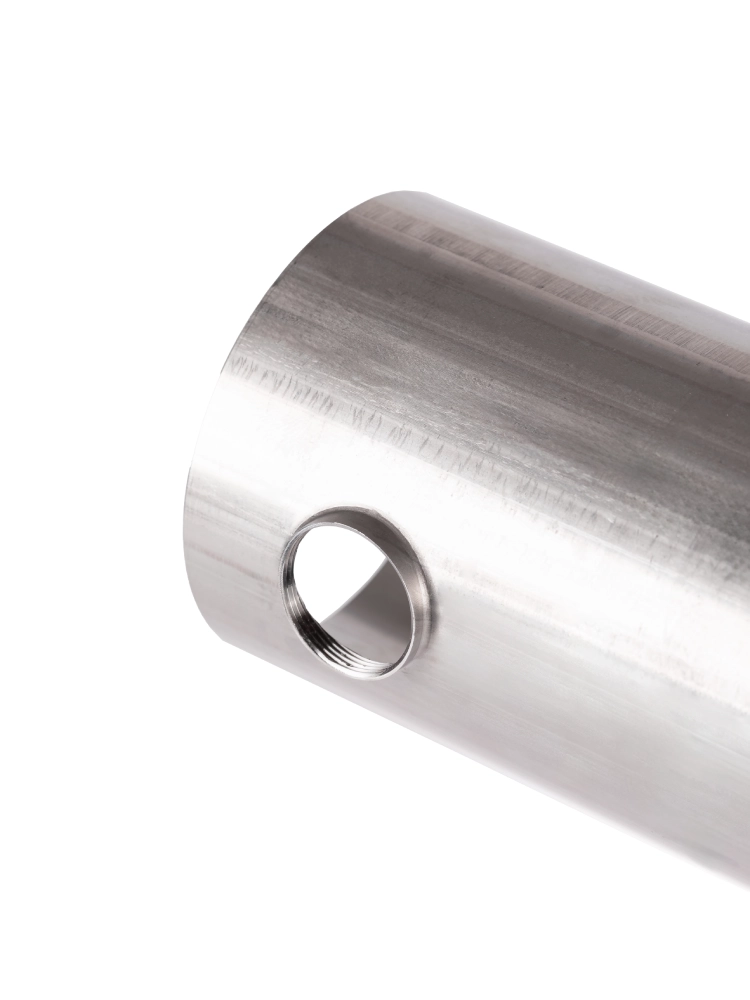

Imagine you need a tube that is not only threaded but also deformed, bent, or cut with a complex geometry. In a traditional approach, you would have to turn to multiple suppliers: one specializing in tube deformation and another in precision mechanical processing like threading. This not only leads to increased transportation and management costs but also extends production times and increases the risk of non-conformity due to communication issues between suppliers.
Our company offers an innovative solution to this problem by integrating the fabrication of threaded pipes with other deformation techniques. We can take a raw tube and, within the same production workflow, bend it, deform it, and apply a precise thread—all without interruptions. This synergy is possible thanks to our experience in both deformation and mechanical processing. Our “machine park” includes machinery specific for both threading and deformation, allowing us to manage the entire lifecycle of a component, from raw material to finished product.
One partner, a thousand advantages
Choosing a supplier that offers both tube deformation and threading means investing in your company’s efficiency. Our goal is to simplify your production process, reducing the complexities and uncertainties that are often associated with managing multiple partners. Here are some benefits that come from process integration:
- Time Savings: A single production workflow means less downtime between phases.
- Cost Reduction: Fewer shipments, less bureaucracy, and less risk of waste due to misalignment between suppliers.
- Guaranteed Quality: The entire process is under our control, which allows us to guarantee maximum quality and conformity to your specifications on every single piece.
- Greater Flexibility: We can adapt quickly to your requests, managing project changes or custom productions efficiently.
Want to discover how we can optimize your production and provide you with a complete service from A to Z?
Contact us, and together we will find the ideal solution for your needs!